GmbH formation in Germany.
€25,000 capital, 3 to 6 weeks.
Standard corporate vehicle in Germany. Notarial formation, Handelsregister entry, tax number, USt-IdNr and bank account, we run the full path.

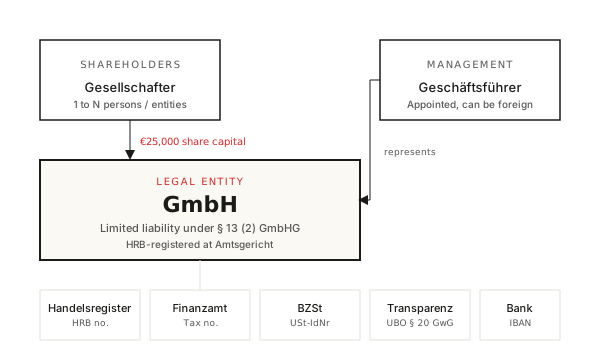
A Gesellschaft mit beschränkter Haftung (GmbH) is the standard limited-liability vehicle in Germany. It is formed by notarial deed (§ 2 GmbHG), registered at the Handelsregister (HRB), and gives shareholders a liability shield under § 13 (2) GmbHG. Banks, large counterparties, procurement teams and regulators treat the GmbH as the default. Its smaller sibling, the UG (haftungsbeschränkt), exists for bootstrappers who cannot park €25,000, but most operational businesses choose the GmbH for credibility, bank access and readiness to scale.
What the Stammkapital really means
§ 5 (1) GmbHG fixes the minimum share capital at €25,000. At registration, § 7 (2) GmbHG requires at least €12,500 in cash to be paid into a blocked account (Einzahlungskonto) before the Handelsregister will accept the application. If you use in-kind contributions (Sacheinlagen), § 5 (4) GmbHG and the Sachgründungsbericht require the full value to be demonstrated.
The paid-in €12,500 is not a fee and not "gone": it sits on the company balance sheet and funds early operations. The point of the capital rule is creditor protection, not cash-burn.
Musterprotokoll vs individual Satzung
§ 2 (1a) GmbHG allows a streamlined Musterprotokoll (template articles) if all three conditions are met: ≤3 shareholders, one managing director, cash contribution. The notarial fee drops significantly (Geschäftswert = Stammkapital only), and the formation is faster. You lose the flexibility of a custom Satzung: no vesting, no drag-along, no share classes, no tag-along.
A custom Satzung costs more at the notary and adds one to two weeks, but lets you build the cap-table structure you actually need. If you plan to fundraise or issue founder-shares with vesting, skip the Musterprotokoll from day one.
Bank account and the blocked-account trap
Before the Handelsregister will accept your application, the capital must be on a blocked bank account (gesperrtes Kapitaleinzahlungskonto). Incumbent banks (Commerzbank, Deutsche Bank, HypoVereinsbank) open blocked accounts but often require non-resident founders to pass a video-KYC call or travel in person. Fintechs (Qonto, Finom) usually cannot open a blocked account themselves but integrate with a partner bank.
Plan two to four weeks for this step. If you need a faster path, buy a shelf GmbH instead: the €25,000 is already paid in, bank account already operational.
Cost breakdown
Typical one-off costs, excluding our legal scope:
- Notary (Beurkundung + Handelsregister filing): €500 to €2,500, depending on Geschäftswert
- Handelsregister fees: €150 to €300
- IHK first-year contribution: €30 to €60
- Transparenzregister UBO registration: no direct filing fee, small annual maintenance
Our scope is case-specific. For a straightforward one-shareholder GmbH with Musterprotokoll, we typically quote €1,800 to €3,500 all-in including notary liaison and post-formation setup.
For non-resident founders
Foreign nationals can own and direct a German GmbH without any residency requirement on either role. § 6 GmbHG imposes qualification restrictions on Geschäftsführer (no recent bankruptcy or fraud conviction) but no residency. In practice, the two friction points are the notarial Beurkundung and the bank KYC: both can be solved by a notarised and apostilled power of attorney for the deed, plus a fintech account for opening the operational banking relationship while the incumbent application runs in parallel.
Read more in our guide: forming a GmbH as a non-resident founder.
After formation: the first 90 days
Once the HRB number is issued, the following must happen:
- Finanzamt registration (Fragebogen zur steuerlichen Erfassung) within one month; tax number (Steuernummer) issued 2 to 4 weeks later
- USt-IdNr request to the BZSt if cross-border trade is expected
- Transparenzregister UBO entry under § 20 GwG, without undue delay after founding
- Monthly VAT Voranmeldung begins (monthly in year 1 and 2 per § 18 (2) UStG)
- Annual Jahresabschluss under §§ 242, 264 HGB, publication at Bundesanzeiger within 12 months of year-end
We run this as a standalone accounting engagement or bundle with formation.
The 7-step formation path
GmbH vs UG vs AG at a glance
| Aspect | UG | GmbH | AG |
|---|---|---|---|
| Statute | § 5a GmbHG | GmbHG | AktG |
| Min capital | €1 | €25,000 | €50,000 |
| Paid-in at registration | Full | €12,500 | €12,500 |
| Reserve duty | 25% of profit | , | Art. 150 HGB for AG |
| Supervisory board | No | No | Mandatory min 3 |
| Mandatory audit | Size-based | Size-based (§ 267 HGB) | Always |
| Formation timeline | 2–4 wks | 3–6 wks | 6–10 wks |
| Formation cost | €300–900 | €700–2,900 | €1,800–5,000 |
| Listing readiness | No | No | Native form |
Often booked alongside this one.
Frequently asked questions
What is the minimum share capital for a GmbH in 2026?
€25,000 under § 5 (1) GmbHG. At registration, at least €12,500 must be paid in cash to a blocked account per § 7 (2) GmbHG. The rest can be called later; until then the shareholder remains on the hook.
How much of the Stammkapital must be paid in at registration?
€12,500 minimum in cash. In-kind contributions require full payment plus a Sachgründungsbericht per § 5 (4) GmbHG.
How long does it take to form a GmbH in Germany?
Realistic end-to-end: 3 to 6 weeks. Notarial deed day one, HR filing day four or five, HRB entry 5 to 15 working days later, tax number 2 to 4 weeks on top. Shelf GmbH is the 24 to 72 hour alternative.
How much does a GmbH formation cost in total?
Government and notary costs €700 to €2,900 one-off. Our legal scope is case-specific, typically €1,800 to €3,500 for a standard one-shareholder Musterprotokoll GmbH. Non-resident cases with apostilles and complex Satzung run higher.
Can a non-resident be the sole shareholder and director of a GmbH?
Yes. § 6 GmbHG imposes qualification (no recent bankruptcy or fraud conviction) but no residency requirement on Geschäftsführer. Bank account opening is the usual friction point for non-residents.
When can I use the Musterprotokoll to skip a custom Satzung?
§ 2 (1a) GmbHG conditions: up to 3 shareholders, one managing director, cash contribution only. If you need vesting, drag-along, tag-along or share classes, skip the Musterprotokoll.
What is the difference between a GmbH and a UG (haftungsbeschränkt)?
Identical liability shield and identical tax. Differences: UG starts from €1 with full paid-in and a 25% profit-retention duty; GmbH starts from €25,000. Banks, VCs and large counterparties prefer the GmbH. Read the comparison in our GmbH vs UG guide.
Is a GmbH a good choice for a holding structure?
Yes. A Holding-GmbH using § 8b KStG gets 95% exemption on qualifying dividends and capital gains from its subsidiaries. See our Holding-GmbH page for the mechanics and the 10% threshold.
What ongoing filings does a GmbH require (annual accounts, UBO)?
Annual accounts under § 242 ff. HGB plus publication at Bundesanzeiger within 12 months (§ 325 HGB). Monthly VAT Voranmeldung. Transparenzregister UBO keep-current under § 20 GwG.
What is the corporate tax rate for a GmbH in 2026?
KSt 15% plus Solz 5.5% on tax (0.825%) plus Gewerbesteuer (14.35 to 17.15% in our 4 cities). Combined effective: Berlin 30.175%, Düsseldorf 31.225%, Hamburg 32.275%, Munich 32.975%. Full breakdown in our corporate tax guide.
Can I form a GmbH online without flying to Germany?
Partly. The notarial Beurkundung can be signed by a notarised and apostilled power of attorney, which lets our notary execute on your behalf. Some banks still require a video KYC call.
What happens between the notarial deed and the Handelsregister entry (Vor-GmbH)?
The entity becomes a Vor-GmbH. It can act in its own name but shareholders and acting directors have personal liability for obligations incurred before HRB entry (§ 11 GmbHG). Keep this window short and do not sign large contracts until the HRB number is issued.
How is a GmbH different from a UK Ltd or US LLC for tax purposes?
GmbH is a corporation (Körperschaft), taxed at entity level (KSt + Solz + GewSt). Dividends to shareholders carry withholding. A US LLC is typically pass-through; a UK Ltd is corporation-tax-transparent only in specific cases. Treaty relief depends on DTA structure. Talk to us about entity-choice for US-DE and UK-DE flows.
Tell us what you need
Engineered from Berlin, Hamburg, Düsseldorf and Munich. One partner per office, English contract, response within one working day.